SCRIMGEOUR, Gavin

ISBN 978-1-922527-50-9
PAPERBACK

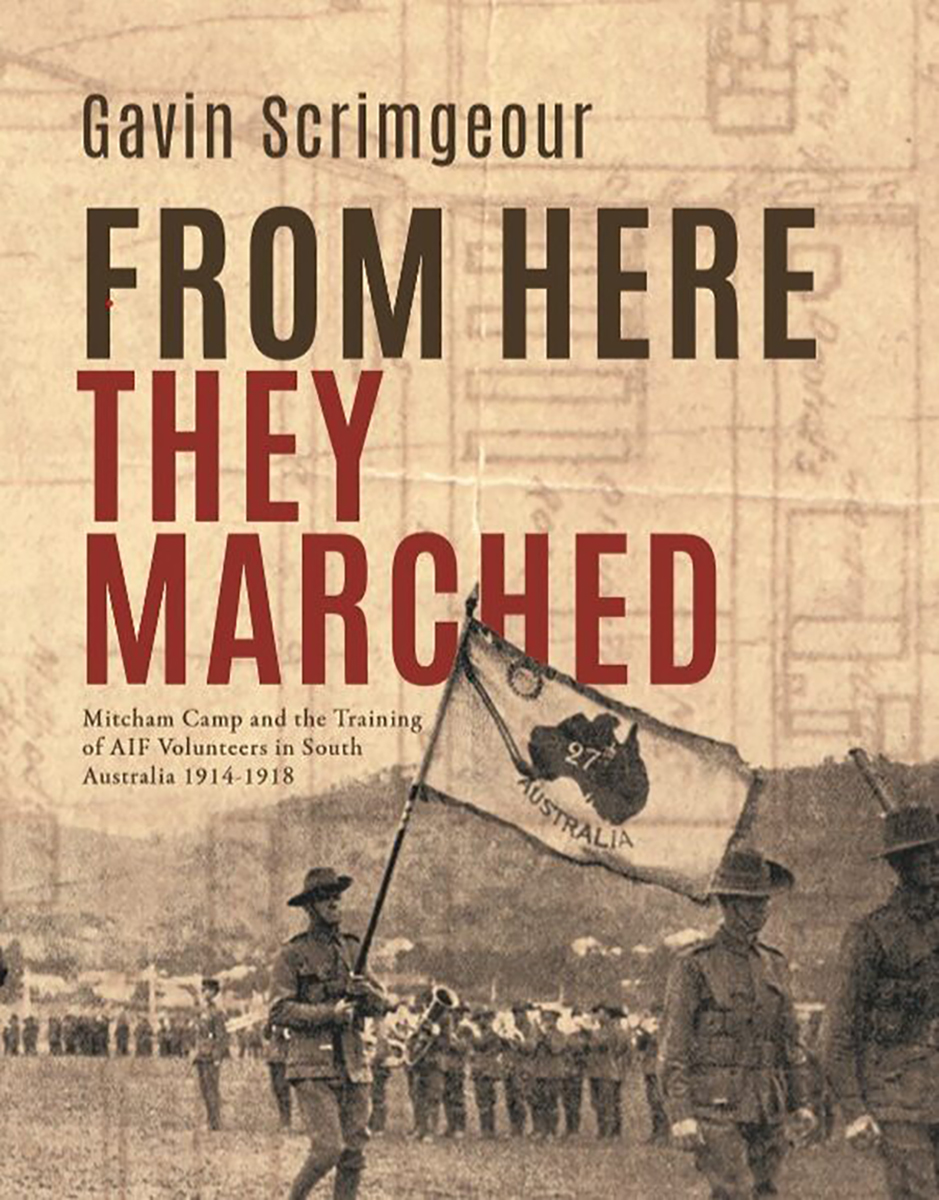
From Here They Marched

THE MITCHAM AIF CAMP, LOCATED IN WHAT IS NOW THE ADELAIDE SUBURB OF COLONEL LIGHT GARDENS, WAS THE TRAINING GROUND FOR THOUSANDS OF SOUTH AUSTRALIAN VOLUNTEERS WHO ENLISTED TO FIGHT FOR THE AIF IN THE FIRST WORLD WAR.

The camp, opened in bare paddocks in early 1915 after earlier camps had proved inadequate, overcame significant early difficulties to become what was proudly claimed to be ‘the model camp for the Commonwealth’.

From Here They Marched tells the story of the camp and how men from all walks of civilian life were brought together and prepared for the discipline of military life and for war.

It shows how the military authorities approached the task of also meeting the physical and social needs of as many as 4400 men at a time, all newly away from their home and families, and facing an uncertain future.

The surviving memories of those who passed through the camp, newspaper reports, the few remaining documents from the camp, and contemporary photographs are used to bring this vibrant, ever changing community of men to life.

The part played by other military training camps in and near Adelaide which were used for short periods during the war is also described. This includes the Morphettville and Ascot Park/Oaklands camps where the men of the earliest contingents did their training before taking part in the landings at Gallipoli.

Mitcham camp is an important part of the historic landscape of Adelaide, and the final chapter presents a case for the preservation of the memory of the camp in Colonel Light Gardens.

DANVERS, Ron

ISBN 978-1-923443-01-3
PAPERBACK

1837 Colonel Light’s Vision for Adelaide


Postulation and Testing a Preemptive Model Plan Adapted by Light for the Capital of South Australia

Colonel William Light’s history has been the subject of several admirable publications, but none have satisfactorily addressed the method he used in designing, surveying and laying out the plan of the City of Adelaide on the topography of the site chosen on December 31, 1836. Although evidence supports there being a preemptive Model Plan produced in London before that date, the connection has generally been missed on how such a plan, following the pattern of many colonial antecedents, could have been simply cut up to fi t the topography of the chosen site.

In postulating the form a Model Plan might have taken by reverse engineering the final plan, it becomes obvious that this was the method used by Light to lay out the plan of the Capital. It was not done in a week from January 3, 1837 as Stretton suggested, but by February 7 the basic cutting up had been formulated and sketched by Light from Green Hill.

About the Author


Ron Danvers LFRAIA is an architect living in the City of Adelaide in South Australia. He was instrumental in introducing urban design to South Australia, becoming the founding Chair of the State Urban Design Advisory Panel. Although he has undertaken major cultural heritage projects in Malaysia and Indonesia, most of his architectural work has been in the City of Adelaide.

He was awarded the RAIA Lachlan Macquarie Award and a National Trust Australian Heritage Award in 1987 for restoration of the Mortlock Library. In 2005, his architecture practice was awarded a UNESCO Asia Pacifi c Heritage Award for Cultural Heritage Conservation for heritage adaptation of the Treasury Buildings in Victoria Square. He was President of the RAIA SA Chapter 1988-90, representing the architectural profession at that time in the South Australian State Planning Review. He was granted the adjunct title of Associate Professor by the University of Adelaide.

ISBN 978-1-923443-01-3
PAPERBACK

1837 Colonel Light’s Vision for Adelaide


Postulation and Testing a Preemptive Model Plan Adapted by Light for the Capital of South Australia

Little Book of Big Book Marketing Tips book cover

Colonel William Light’s history has been the subject of several admirable publications, but none have satisfactorily addressed the method he used in designing, surveying and laying out the plan of the City of Adelaide on the topography of the site chosen on December 31, 1836. Although evidence supports there being a preemptive Model Plan produced in London before that date, the connection has generally been missed on how such a plan, following the pattern of many colonial antecedents, could have been simply cut up to fi t the topography of the chosen site.

In postulating the form a Model Plan might have taken by reverse engineering the final plan, it becomes obvious that this was the method used by Light to lay out the plan of the Capital. It was not done in a week from January 3, 1837 as Stretton suggested, but by February 7 the basic cutting up had been formulated and sketched by Light from Green Hill.

About the Author


Ron Danvers LFRAIA is an architect living in the City of Adelaide in South Australia. He was instrumental in introducing urban design to South Australia, becoming the founding Chair of the State Urban Design Advisory Panel. Although he has undertaken major cultural heritage projects in Malaysia and Indonesia, most of his architectural work has been in the City of Adelaide.

He was awarded the RAIA Lachlan Macquarie Award and a National Trust Australian Heritage Award in 1987 for restoration of the Mortlock Library. In 2005, his architecture practice was awarded a UNESCO Asia Pacifi c Heritage Award for Cultural Heritage Conservation for heritage adaptation of the Treasury Buildings in Victoria Square. He was President of the RAIA SA Chapter 1988-90, representing the architectural profession at that time in the South Australian State Planning Review. He was granted the adjunct title of Associate Professor by the University of Adelaide.

ANDREW, Rob and Dr Glenda Dixon

ISBN 978-1-923523-16-6
PAPERBACK

ISBN 978-1-923523-17-3
HARDCOVER

PUBLISHER: GREEN HILL PUBLISHING

The “NO” Test


and other approaches for addressing domestic violence

The “no” test is simple. A man passes it if he graciously accepts “no” from his partner. If he attempts to persuade her to change her mind, he fails.

This book will be of interest to anybody who is concerned about the problem of domestic violence.

The man who is abusive and the woman who suffers the abuse are often misrepresented. The “No” test provides alternatives to these misrepresentations so that a man can be held accountable for all his actions and a woman’s ever present resistance to oppression is recognised.

The “No” test is also a resource for those in the helping professions with discussions on the ethics of practice, exploring the importance of language and a chapter on the crafting of questions – the all important key to therapeutic conversations.

Finally, the ideas are demonstrated in practice in therapeutic conversations with four composite individuals, two of whom are a married couple. The four represent the diverse individuals the authors have encountered in many years of practice.

The book aims to expose how the problem of domestic violence is perpetuated by its frequent misrepresentations and in so doing provide a better understanding of domestic violence for the benefit of all.

Includes therapeutic conversations with individuals to illustrate the book’s core concepts.

Little Book of Big Book Marketing Tips book cover

About the Authors


ROB ANDREW has been working in the domestic violence field since 1993 counselling men and women and co-facilitating men’s and women’s groups. His professional fascination lies in encouraging men to examine their attitudes to better guide them towards respect and responsibility, and in
empowering women to unveil their ongoing resistance to oppression, commitment to dignity, and hopes for a better life. When he’s not working, Rob enjoys riding his bike around the scenic shores of the Swan River.

GLENDA DIXON began working in the area of domestic violence in 1994. She has a Ph.D. in counselling specialising in domestic violence. She has worked in NGO agencies, private practice and has lectured in counsellor training programmes. In her spare time Glenda enjoys reading, biking the trails of central Otago, spending time with family and travelling.

NITSCHKE, Michael

ISBN 978-1-923008-4-74
PAPERBACK

Leading out of Loss

In a world of suit-and-tie CEOs, the leaders who wear their hearts will win

By age 30, Michael Nitschke had lived a life well beyond his years. He’d lost his mum to mental illness and his dad to cancer in quick succession. The Nitschke name, while revered in the community, carried a turbulent history with a devastating legacy.

Part-memoir, part-business wisdom, Leading Out of Loss is a coming-of-age story – of human endurance, transcendence, and alchemising suffering into success.

This searingly honest book delicately deals with grief, the cobwebs within a family lineage, divine intuition, self-reinvention, and Michael’s personal and professional epiphany: the power of vulnerability, in business and in life.

Leading Out of Loss is a testament to depth of the human spirit – and gives you the permission to lead with heart and humility, embracing vulnerability as your greatest asset.

STEPHENS, Edward Ted

ISBN 978-1-923386-92-1
PAPERBACK

The Ormonds of Borriyalloak


The Story of the Great Philanthropist Hon Francis Ormond and His Family

Francis Ormond, a great Victorian philanthropist was fired by his passion to bring education to the masses. Not having children he contributed millions of pounds to educational buildings and institutions.

Francis Ormond travelled from Scotland to Shelford near Geelong in 1843 with his father Captain Francis Ormond, Mother Isabella and her tiny baby Alfred. There they built a hotel on the road to the Western District. They were the only people making money during a rural depression and they took over several large grazing runs including thousands of sheep.

Later Francis married his childhood sweetheart Mary Greeves and they moved to Borriyalloak near Skipton. Appalled at their workers lack of education, they taught them themselves in the evenings. In 1853 when Gold was discovered, thousands of immigrants needed food so Francis’ future was assured.

Francis built Ormond College, a residence for country students to gain an education. Then to enable them to obtain a technical education, he built RMIT. He established the Conservatorium of Music. From this beginning we now have the Melbourne Symphony Orchestra.

In Geelong Francis contributed the first money towards the Gordon Institute and he was Chieftain of the Commun Na Fienne Society until his death. He contributed to the establishment of many rural secondary schools. He gave a great amount of money to finish building St Pauls Cathedral in Melbourne as a memorial to his first wife who was an Anglican.

He died in France in 1888 and his second wife Mary Oliphant brought him back to probably the largest funeral ever to pass along Ormond road to the cemetery in Geelong.

ISBN 978-1-923386-05-1
PAPERBACK

The Langlands


The History of the Langlands Family in Melbourne and Horsham

IN 1840 ROBERT LANGLANDS, A YOUNG SCOTTISH MAN, TOOK A HUGE STEP FOR LOVE AND LEFT HIS FAMILY TO EMBARK ON A ROMANTIC ESCAPADE ACROSS THE OCEAN…

He shocked his family by deciding to pursue his lady friend who had been deported to Australia for a minor misdemeanour.

After arriving in Melbourne, Robert immediately set off to Sydney to ask his girlfriend, Agnes, to marry him.

Robert’s brother, George, and his wife, Betsy, during his leave, and having fallen on hard times, had become interested in an offer to start a Post Office in Western Victoria.

So, they loaded their five children (including Ted’s future grandmother Margaret, at age six) on board three bullock drays and set off to find a survey peg 300 miles away on the Wimmera River marked as “A place to be called Horsham”.

Robert set up a foundry in Flinders Street in 1841 which thrived and Horsham grew around the Langlands store.

The rest, as you will discover in this book, is wonderful history…

“An authentic telling of real life in a part of our history not to be forgotten… A wonderfully written and engaging book…”
Dillon, Readalot Magazine reviewer

About the Author


A retired farmer, Ted Stephens comes from a literary family. His grandfather Edward James Stephens founded the “Horsham Times” in 1873. Ted’s father Harold was brought up in his father’s many Wimmera newspapers and wrote prolifically for “The Leader”, “Weekly Times”, the “Gadfly” and others. They wrote their history as it happened, enabling Ted to publish their story, “The Langlands”, in 2024. This gave him the will to research and write about the forgotten Ormond family. After 60 years with the CFA, church and local committees, writing local histories, and 53 years developing a world-class collection of historic machinery at the Geelong Showgrounds and now a museum, he has been honoured as a Knight of the Order of St John of Jerusalem Hospitaller for his contribution to society.

HUGHES, Glen

ISBN 978-1-923443-83-9
PAPERBACK

Down Under


Poems from the Australian Bush

The author’s reflections of early life experiences growing up on an isolated sheep and cattle station known as Muloorina, which lies adjacent to Lake Eyre and the Tirari Desert, all stories conveyed in verse as Bush Poetry.

A companion to Campfire Memories and Happy Campfires.

About the Author


It is with heartfelt pride that I present my third offering of Bush Verse, Down Under for your appreciation.

Topics are many and varied, mostly based on life experiences of topical conversation around numerous Campfires, crisscrossing the desert, touching on history, weather events and characters met along the way.

I have a deep respect for this part of the world, (The Lake Eyre Basin) that I’ve been lucky enough to enjoy for just a blink in time, and am now grateful to share my backyard, to my many readers and followers, expressing my thoughts on a life well lived, narrated in rhyme.

For those of you who wish to experience Australia’s greatest inland lake system, I encourage you to immerse yourselves in this timeless landscape to appreciate the aura that consumes your senses from this natural world of wonder!

I penned Ancient Scapes for your appreciation of my feelings, captured within the heart of the Lake, that I’ve been lucky enough to experience.